Cold water immersion (a.k.a., “ice baths”) has become a popular method amongst exercise enthusiasts and athletes to enhance recovery after an intense training bout. The strategy involves exposing either the trained limb or the whole body to very cold liquid temperatures. According to p...
Brad Schoenfeld, Ph.D, C.S.C.S., is an internationally renowned fitness expert and widely regarded as one of the leading authorities on body composition training (muscle development and fat loss). He is a lifetime drug-free bodybuilder, and has won numerous natural bodybuilding titles.
I was recently interviewed for an article by Men’s Health Magazine on how to target the lower aspect of the abdomninals. As discussed in the article, there is evidence that you can increase activation of the lower abdominal region by initiating a posterior pelvic tilt during performance of exercises such as the reverse crunch and hanging knee raise. Here is a video depicting proper performance:
Now what isn’t clear is whether the increased activation of the lower abs translates into greater muscle development over time. There is emerging research that muscle growth is correlated to the region of greatest activation, but the evidence is far from conclusive at this point. Taking all things into account, there is a potential benefit to performing targeted lower abdominal exercise for those seeking to maximize development in this region. It probably won’t make much of a meaningful difference for the average gym-goer, but for those who aspire to develop their physique to the utmost (i.e. bodybuilders) it may well provide a tangible benefit.
First off, I want to apologize for my lack of recent posts to the blog. I’ve been swamped with projects as well as a seemingly endless sea of papers associated with my Ph.D. studies. Hopefully my workload will ease a bit in the coming weeks and I’ll have more time to provide ongoing content.
In the meantime, I wanted to take this opportunity to comment on the reaction by a select few fitness professionals to the review paper that Bret Contreras and I wrote titled, To Crunch or Not to Crunch. A small but vocal portion of the strength and conditioning community seems to feel that it’s heresy to challenge their dogged position that crunches are inherently evil. One strength coach has gone so far as to claim that we were “deliberately trying to be controversial” by stating that spinal flexion exercise is not necessarily a one way ticket to back surgery. Amazing! I’m of the belief that it’s controversial to claim the crunch — an exercise that has seemingly been around since the dawn of man — has no place in a person’s training routine. Go figure…
Here are the facts: Bret and I are not only practitioners, but scientists as well. When we wrote the article, our sole intention was to seek the truth. We reviewed hundreds of peer-reviewed articles on the subject — pretty much every study that was in any way related to spinal flexion — and took an unbiased view in our reporting of what we found. Based on the body of literature, there simply is not sufficient evidence to support the contention that healthy individuals should abstain from performing crunches. Moreover, there is even some research to suggest that it may have a positive effect on spinal health. Should evidence come out in the future that refutes these findings, we’ll be the first to acknowledge it and rethink our position. But as evidence-based practitioners, the recommendations we made in our paper are solidly in line with current research, personal experience, and the needs of the individual. This is the essence of evidence-based practice.
Are crunches for everyone? Certainly not. We clearly state in the article that they should be avoided by those with existing spinal issues such as disc herniation, disc prolapse, and/or flexion intolerance. But understand that the same is true for any exercise. Squats, presses and rows are all terrific exercises, but they may be contraindicated for a given individual depending on his/her goals, abilities, and injury status. As Stuart McGill has been aptly quoted as saying subsequent to publication of our article, “Crunches are neither bad nor good. The most important thing is the assessment to determine what’s right thing for the person in front of you. The next most important thing is to respect the load/posture/repetition variables in your algebra, i.e. don’t overwork the tissue beyond the ability to adapt or beyond its tolerance to failure.” I couldn’t agree more.
Unfortunately, there are those who choose to take a cult-like stance with respect to fitness. Rather than embracing new information, they instead cling to their rigidly-held beliefs and flame against anyone who poses a threat to their stance. This kind of attitude is not only unscientific, it’s unprofessional and can only set back exercise science and have a negative effect on the fitness industry as a whole. Ultimately everyone loses, including the general public who are caught in the crossfire.
Here’s an interesting anecdote. Back in the early 1960’s, a professor from the University of Texas named Karl Klein railed against the performance of deep squats. Klein conducted studies showing that weight lifters who frequently performed deep squats displayed an increased incidence of laxity in the collateral and anterior cruciate ligaments compared to a control group that did not, leading him to conclude that squatting below parallel had a detrimental effect on ligamentous stability. “Anything below a half knee bend,” he was quoted as saying in a 1962 Sports Illustrated article, “is useless and ruinous.” (Side note: The SI article was ironically titled “The Knee is Not for Bending.” Sound familiar? The similarities are eerie).
Now Klein was a distinguished researcher at the time and, as you may imagine, his claims had far reaching implications: The US Army subsequently removed squat jumps from their training protocols; the New York State school system banned deep knee bends from gym class; and the American Medical Association came out with a position statement cautioning against the performance of deep knee exercises because of their potential for severe injury to the internal and supporting structures of the knee joint. The upshot: For years, deep squats were widely considered passe. In fact, due to one man’s crusade, the negative view of deep squats is still being felt 50 years later as some continue to admonish the exercise as inherently dangerous.
Fast forward to today. Research has ultimately refuted Klein’s findings. No correlation has been found between deep squatting and ligamentous stability, including results from studies that attempted to replicate Klein’s methods. In fact, the prevailing body of evidence shows that ACL and PCL forces actually diminish at higher knee flexion angles. I covered this subject extensively in my NSCA Hot Topic article, The Biomechanics of Squat Depth. If you haven’t already given it a read, you may well find it enlightening, especially in the context of the current controversy over spinal flexion exercise. Could there be any parallels between the two topics? As they say, time will tell.
Bottom line is that it’s fine to have an opinion on a subject provided you’re open to other viewpoints. With respect to spinal flexion, I encourage you to read the research and draw your own conclusions rather than being swayed by some opinionated “fitness guru.” With a firm understanding of the available evidence, we can then debate the topic logically, rationally, and civilly to facilitate a better understanding of the issues. We shouldn’t care who is right or wrong, just that we ultimately get it right. Only through an open exchange of ideas can science move forward. This way, everyone wins.
Several recent bloggers have weighed in on the review article I co-wrote with Bret Contreras about the potential risks and rewards of spinal flexion exercises. First, the Cooper Institute wrote a post titled Controversy Over Crunches, the Cooper team does a good job summarizing the basic info on the topic. Similarly, my colleague Jonathan Ross wrote an article for the American Council on Exercise titled When Pigs Crunch that also summarized the issue nicely. I encourage you to read both posts.
It’s nice to see that our article stirred up debate on the subject, and that the pendulum has now swung back to center. If you still haven’t read our original article To Crunch or Not to Crunch, you can do so at the link below. Due to the publicity that the article generated, the NSCA has made the article free to view:
I was recently interviewed by the New York Times about the review article that I co-wrote with Bret Contreras titled, “To Crunch or Not to Crunch.” The Times article explored the topic as to whether crunches were worth the effort. My quotes were somewhat misconstrued here.
To set the record straight, I stated that it is generally superfluous to perform hundreds of crunches in a training session. The reason? Doing so has little applicability to every day life. After all, when do you repeatedly flex at the spine hundreds of times? As a general rule, core endurance is most needed in static postures and this is best achieved through isometric exercise, not flexion movements.
On the other hand, I pointed out that dynamic core strength can be important for carrying out many sporting movements and activities of daily living (as well as to optimize the “six pack” appearance that many people covet). To develop dynamic strength and muscle development, you need to perform low-to-moderate repetitions (within a range of about 6-15 reps). In the times piece, it came across as if I was advocating just a single set of crunches. This isn’t the case. Several sets are required to achieve optimal results.
Moreover, the sets must be challenging. If you can easily perform the target rep range, you need to add resistance! This can be achieved by either holding a weight (i.e. dumbbell, weighted plate, medicine ball,etc) during a crunch, or by performing spinal flexion on a cable apparatus (e.g. kneeling cable crunch).
On a side note, I’m happy to report that the NSCA has made the review article that Bret and I wrote free to read. Generally you must be a member of the NSCA to get access to articles appearing in the Strength and Conditioning Journal. However, because the article has received so much attention, the powers that be have provided open-access to all. Give it a read at the link below and let me know your thoughts.
Here’s a link to the T-Nation article I co-wrote with Bret Contreras titled, To Crunch or Not to Crunch. The article refutes the claims made by some that crunches damage the spinal discs, discussing the relevant evidence on the subject. It complements the review article we recently published in the NSCA Strength and Conditioning Journal, and is a little more “consumer-friendly” for those without a scientific background.
In a recent post, I mentioned that I attended John Cissik’s thought-provoking presentation on core training at the 2011 NSCA National Conference. In short, John reviewed the peer-reviewed literature on the effects of core training on athletic performance, injury, and pain. His conclusion: contrary to popular belief, there is not much evidence that core training significantly improves any of these variables.
John was nice enough to consent to interview for Workout911.com readers to expand on his views on core training. Whether you ultimately agree with his conclusions or not, it should at least highlight the need for more research on the subject.
BJS: Thanks for consenting to this interview. Tell us a little about your background.
Thanks for the opportunity! Like a lot of people in our field, I wear many hats. I work as the Director of Fitness and Recreation at Texas Woman’s University. I also spend a great deal of time working with track and field programs on their strength and conditioning. I have worked as a strength and conditioning coach at several levels, worked as a personal trainer, have experience in rehab, and have even taught at a university. I have a master’s in exercise physiology, an MBA with an accounting focus, and certifications from the NSCA, USA Track and Field, and the old US Weightlifting Federation. I’ve written a number of books and articles on strength and speed training, done many presentations on these subjects, and even done four videos. I also serve as an associate editor for Strength and Conditioning Journal.
BJS: You challenge the commonly held belief that direct core training improves athletic performance. What led you to this conclusion?
I was asked to review an article on testing core stability. The article had several “field” tests along with norms, which is fine. What interested me was a statement that the article made which was essentially that everyone needs to have their core stability assessed prior to being allowed to engage in movement because movement is so inherently dangerous. At the time I felt that things have gotten a little silly with regards to core training and I thought it was time to actually seek our and review the literature on this topic.
One of the key claims regarding the efficacy of core training is that it improves athletic performance. If you wanted to demonstrate this through research, you’d have a group of subjects engage in core training and compare them to a group that doe not. Then see which group improves the best on athletic performance measures. Surprisingly, with all the claims associated with core training, this kind if research is really difficult to find.
There is a lot of research that shows that core training improves core strength and endurance. There is a lot of research to show what exercises are best at recruiting specific muscles. When it comes to athletic performance, the research is at best conflicting at and worst it shows that core training is not effective.
Research that looks at core training and its ability to improve performance does not establish that it is a magic bullet. Now, some research establishes a relationship between some measures of athletic performance and core endurance, but it is unclear if one causes the other. For example, does better core endurance create a stronger squat or does the stronger squat create better core endurance?
BJS: Many fitness pros claim that core training helps to prevent injuries, particularly those to the lower back. This is predicated on the belief that strengthening the muscles supporting the spine makes this region less susceptible to injury. What’s your take on this?
Currently, there is not a very good understanding on what causes lower back injuries. The medical literature classifies lower back injuries to two types; specific and non-specific. Basically specific are the result of an incident and can be seen through imaging. This represents about 10% of lower back pain. The other 90% are non-specific which means that there is not an established “incident” which caused it and it cannot be seen via imaging. There is no consensus in the literature about what causes either kind of injury. As a result, it’s impossible to say that exercises addresses any of the things that causes these injuries. Research that looks at exercise “preventing” low back injuries is inconclusive.
BJS: What is your opinion on performing core exercises as a treatment for those with lower back pain.
Exercise seems to be effective at reducing pain and improving quality of life for people with chronic (grater than 12 weeks) low back pain. It seems to be ineffective for people suffering low back pain for fewer than 12 weeks. The important thing to note here is that any kind of exercise seems to be effective; stretching, aerobic exercise, general strength training, and core training. There does not seem to be a best kind of exercise for chronic low back pain.
BJS: You have discussed the differences between specific lower back pain and non-specific lower back pain. Some fitness pros claim that there is no such thing as “non-specific lower back pain.” How do you respond?
Those are not my terms. Those terms come from the Journal of Strength and Conditioning Research, Medicine and Science in Sports and Exercise, Spine, the European Spine Journal, the British Medical Journal, and JAMA. I understand it’s fashionable to bash medicine, but I’d rather take a sick or injured family member to a medical doctor as opposed to a fitness pro that thinks that they know more.
BJS: Given the evidence, do you think there is any value in training the core with specific exercises or does the core get sufficient work from performing multi-joint exercises so that direct core training is unnecessary?
At the end of the day, anything that gets someone into the gym is a good thing. If it’s core training, Cross Fit, yoga, Zumba, Olympic lifting, whatever it takes to get someone in the gym. I think core training is great from that standpoint, it’s great for vanity, but it is not a magic bullet. Many free weight exercises (squats, deadlifts, and cleans) activate the core muscles just as well as core exercises. So when I only have a limited amount of time to work with athletes, I include some core work to address vanity issues but my focus is on multi-joint exercises.
BJS: Any closing thoughts about core training?
Core training is a victim of poor science, marketing hype, and stretching research to say something that it doesn’t. Many of the claims are unsubstantiated or simply wishful thinking. When it comes to working with athletes, we’re always looking for some type of magic bullet but these do not exist and they do not replace hard work and structured programming.
No exercise has been more maligned in recent years than the abdominal crunch. That’s right, the good old crunch, a staple exercise in almost every athletic program, is constantly dissed by certain fitness professionals as being non-functional and, worse, a potential hazard to spinal health. I have co-authored a peer-reviewed article with my good friend and colleague Bret Contreras that evaluates the current research on spinal flexion exercises such as the crunch and draws relevant conclusions based on the evidence. The article appears in the current issue of the Strength and Conditioning Journal. You can view the article at the following link: To Crunch or Not to Crunch.
One of the more attention-grabbing criticisms on the topic is that crunches have a negative effect on posture. The theory goes something like this: Crunches shorten the rectus abdominis (i.e. the “six pack” muscle). Since the rectus abdominis spans from the sternum/rib cage to the pelvis, continually shortening the muscle will pull down your ribcage, ultimately resulting in kyphosis (i.e. a roundback posture). It’s an interesting theory. It’s also completely unfounded.
As with many theories, its basis has a kernel of truth. Specifically, placing a muscle in a shortened position for a prolonged period of time does in fact cause it to assume a shorter resting length. For example, if you immobilize your arm in a cast at a flexed position for several weeks, your arm will tend to remain flexed once the cast is removed. This is due to an adaptive response whereby the elbow flexors (i.e. biceps, brachialis, etc) lose sarcomeres in series (Toigo & Boutellier, 2006). This has been coined “adaptive shortening.”
There also is some evidence that certain types of exercise can affect the number of sarcomeres in series. Lynn and Morgan (1994) showed that when rats climbed at an incline on treadmill (i.e. repeated shortening contractions), they had a lower sarcomere count in series than those who walked at a decline (i.e. lengthening contractions). This suggests that repeated concentric-only actions lead to a decrease in the number of sarcomeres in series while exercise consisting solely of eccentric contractions results in a serial increase in sarcomere length. Similar results have been noted by other researchers (Butterfield et al. 2005; Lynn et al. 1998).
Perhaps you can see the flaw in hypothesizing that performing a crunch will shorten the rectus abdominis: namely, crunches are not solely a shortening exercise! Rather, the movement also involves eccentric actions where the rectus abdominis is returned to its resting length. Thus, any potential negative effects of shortening contractions on sarcomere number are counterbalanced by the lengthening effect of the eccentric actions (Butterfield et al. 2005; Lynn et al. 1998). The net result is no change in resting length and thus no negative effect on posture.
Some anti-crunch proponents take an alternate hypothesis, claiming that performing spinal flexion exercises (i.e. crunches) overly strengthens the rectus abdominis to the the point that it overpowers its antagonists and thereby pulls down on the ribcage. Again, this is a straw man argument. Certainly it’s true that an imbalance between muscles can cause postural disturbances. I’m sure you’re familiar with guys who perform the “nightclub workout” (chest and arms every time they hit the gym) and end up so internally rotated that they have difficulty scratching the back of their head. Does this mean you shouldn’t perform chest presses and arm curls? Certainly not! The issue here is one of poor program design, not an indictment of presses and curls. Simply train the antagonistic muscles and there’s no postural problem.
With respect to crunches, the same principle holds true. Sure, if you perform a gazillion crunches every day and don’t train other muscle groups then you’re setting yourself up for a postural deviation. But this is a non-issue as long as you adhere to a balanced routine that emphasizes strengthening of the back extensor muscles (Sinaki et al. 1996; Mika et al. 2005). And performance of virtually any standing, non-machine based exercise will heavily involve the posterior core muscles that antagonize the rectus abdominis (Schoenfeld, 2010; Lehman, 2005). This will negate any potential “over-strengthening” of the rectus abdominis associated with the crunch. In fact, the average person tends to have weak abdominals (Morris et al. 2006), so they could very well benefit by directly strengthening the anterior core musculature.
To sum things up, there is no convincing evidence that performing crunches as part of a total body resistance training routine will have any negative effects on posture (assuming there is no inherent postural issues to begin with). This is yet another instance where a theory can seem logical on the surface but have little basis of support once you look deeper into the facts.
Stay Fit!
Brad
References
1. Butterfield TA, Leonard TR, Herzog W. Differential serial sarcomere number adaptations in knee extensor muscles of rats is contraction type dependent. J Appl Physiol. 2005 Oct;99(4):1352-8
2. Lehman GJ, Gordon T, Langley J, Pemrose P, Tregaskis S. Replacing a Swiss ball for an exercise bench causes variable changes in trunk muscle activity during upper limb strength exercises. Dyn Med. 2005, 4:6.
3. Lynn, R and Morgan, DL. Decline running produces more sarcomeres in rat vastus intermedius muscle fibers than does incline running. J Appl Physiol 77: 1439–1444, 1994
4. Lynn R, Talbot JA, Morgan DL. Differences in rat skeletal muscles after incline and decline running. J Appl Physiol. 1998 Jul;85(1):98-104.
5. Mika A, Unnithan VB, Mika P. Differences in thoracic kyphosis and in back muscle strength in women with bone loss due to osteoporosis. Spine (Phila Pa 1976). 2005 Jan 15;30(2):241-6.
6. Morris CE, Greenman PE, Bullock MI, Basmajian JV. (2006), Vladimir Janda, MD, DSc: Tribute to a Master of Rehabilitation. Spine, 31(9), 1060-4
7. Schoenfeld, BJ (2010). Squatting kinematics and kinetics and their application to exercise performance. Journal of Strength and Conditioning Research, 24 (12), 3497–3506
8. Sinaki M, Itoi E, Rogers JW, Bergstralh EJ, Wahner HW. Correlation of back extensor strength with thoracic kyphosis and lumbar lordosis in estrogen-deficient women. Am J Phys Med Rehabil. 1996 Sep-Oct;75(5):370-4.
9. Toigo, M and Boutellier, U. New fundamental resistance exercise determinants of molecular and cellular muscle adaptations. Eur J Appl Physiol 97: 643–663, 2006
Hands down, no other body part gets more attention than the abs. It’s not even close. Unfortunately, there are more myths associated with the best way to trim and tone midsection than any other body part. Falling prey to these myths not only diminishes results, but you also may increase the potential for an injury.
So how do you go about deciphering ab training fact from fiction? Read on…
MYTH #1: Training the abs will give you a flat stomach.
Contrary to popular belief, you cant spot reduce fat. It’s a physiologic impossibility. When you exercise, fat is utilized (i.e. burned) from all areas of the body; you can perform crunches until the cows come home but it will have virtually no effect on losing those love handles or blasting that beer belly. What’s more, the calories expended during ab exercises are very low. There are far better exercises to expedite fat loss than crunches and side bends, particularly those that work multiple muscle groups such as squats, presses, and rows. Now training your abs will develop the underlying muscle, which is essential if you want that coveted “six pack.” But if there is a layer of fat obscuring your muscles, no one will ever see what you’ve worked so hard to develop.
MYTH #2: The lower and upper abs are separate from one another.
The abs are one long sheath of muscle–not two separate entities. Any ab exercise you do is going to involve both the lower and upper abdominal areas. However, studies show you can shift the emphasis more toward the lower or upper regions by performing specific exercises. Specifically, exercises that bring the chest toward the pelvis (crunch-type exercises) target the upper region of the abs, while exercises that bring the pelvis toward the chest (reverse curls) target the lower abdominal region.
MYTH #3: You should perform ab exercises every day for best results.
It has been taken as gospel that the abs are somehow different from other muscles and respond best to daily training. Nonsense, at least if getting a six-pack is your goal. You wouldn’t think of training the biceps or the quadriceps every day, would you? Well, the abs have the almost the same percentage of “fast twitch” to “slow twitch” muscles as the biceps and the quads. This means they are designed just as much for strength as for endurance. Realize that your muscles develop during rest. When you train, you’re actually breaking down muscle tissue. Short change results and you shortchange the recuperative process, thereby impairing results. Approximately 48 hours rest is needed between training sessions for a given muscle group–and that includes the abs.
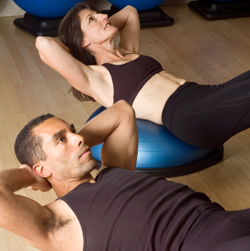
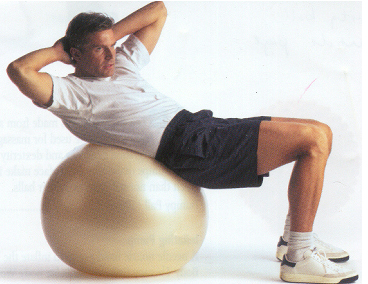
MYTH #4: During the crunch, you should place your hands behind your head for support.
More times then not, people are taught to support their head with their hands when doing crunches. Bad idea. You see, when you clasp your hands behind your head there is a reflexive tendency to pull on the neck muscles. This greatly increases the risk for straining your neck muscles, especially towards the end of a set when you begin to fatigue and are struggling to perform those last few reps. I cringe watching some people yank their heads up as they crunch; they’re an injury waiting to happen. Ouch! The best advice is to place your hands behind your chest or put your fists at your ears. Your neck will thank you. For more detailed info on this myth, see my post Do Crunches Lead to Neck Pain?.
So there you go. Heed these truisms about ab training and you’re well on your way to a better workout…and a firmer midsection!
Virtually every time I walk into a gym I see people performing crunches with their hands clasped behind their heads. Most often I end up cringing as I watch them yank themselves up from the floor, their necks flexing up and down like a bobblehead doll. It’s a surefire recipe for neck pain. “But wait,” many say, “this helps to support my neck.” Right? Well, not really…
Understand that the primary muscle that supports the head during the crunch is called the sternocleidomastoid (SCM) – a strap-like muscle situated on both the left and right sides of the neck. The key point to remember here is that the SCM resides toward the front of the neck. Where does neck pain from performing crunches generally occur? The back of the neck!
With that in mind, it should be apparent that placing your hands behind your head during ab exercises is invariably a bad idea. Here’s why: When the hands are clasped behind the head during spinal flexion (a crunch), there is a reflexive tendency to pull on the upper portion of the trapezius muscle, which resides on the back of the neck. This is especially true as a set becomes more difficult and you’re struggling to complete those last few reps. In addition to significantly increasing the potential for a neck strain, you also introduce momentum into the movement, thereby decreasing the effectiveness of the exercise in developing your abs. A bad combination.
So what to do? For best results, keep your hands folded across your chest or, if you prefer, make a fist and keep them at your ears. This will ensure that the action takes place only at the point of interest: your abs, not your neck. If your neck muscles aren’t strong enough to perform the movement properly, consider using a device like an ab roller or one of the many ab machines available in your local gym. These units provide a cushioned support for your head that won’t pull on your neck muscles during training. Regardless, supporting your neck with your hands isn’t the answer as it will only serve to exacerbate neck problems and impede results. Avoid it.











 Entries (RSS)